The framework.
What is Te Pūtake?
Five interconnected concepts from te ao Māori, at the core of Tiriti-dynamic practice.
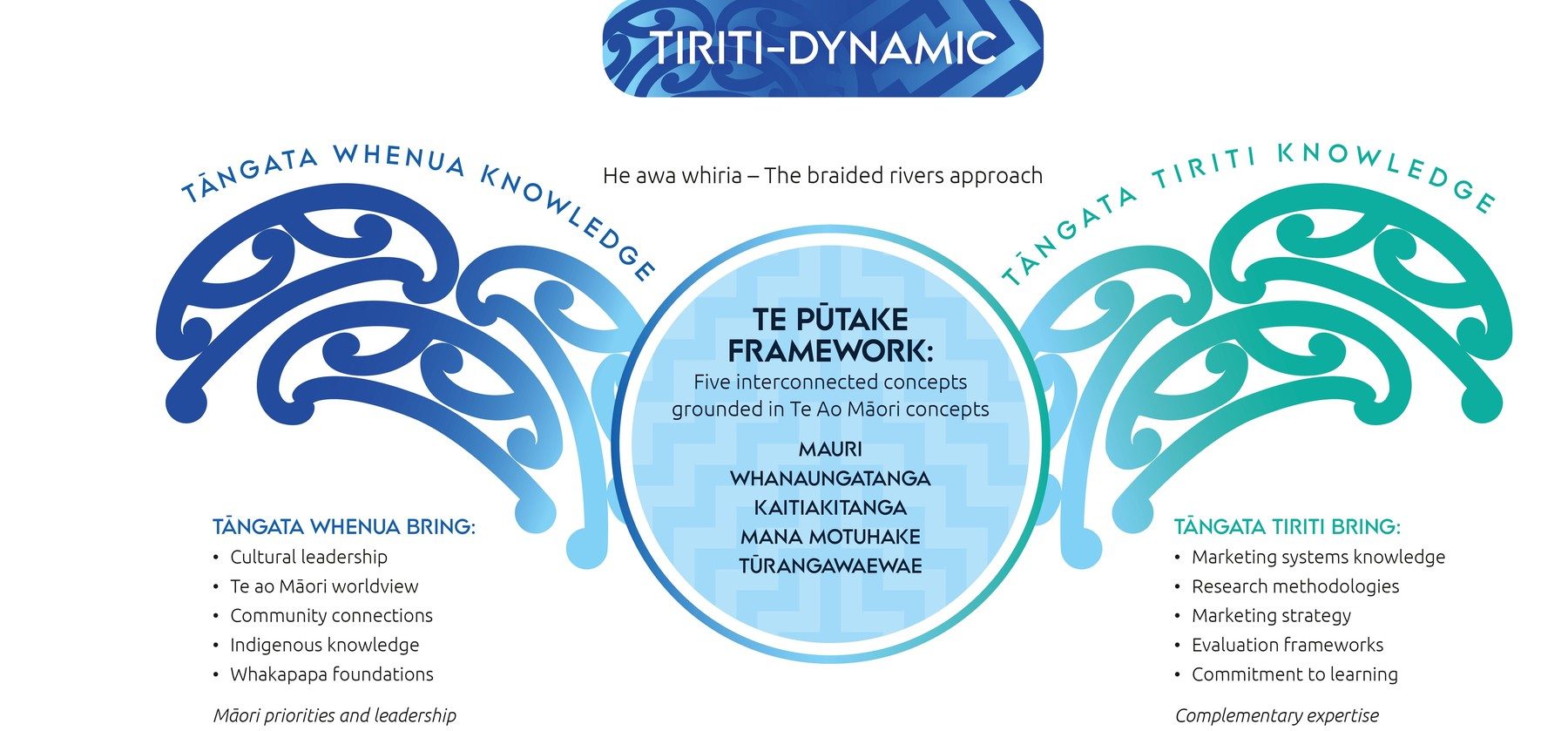
Te Pūtake is the core of Tiriti-dynamic practice: five interconnected concepts from te ao Māori. They are mauri, whanaungatanga, kaitiakitanga, mana motuhake and tūrangawaewae.
Dr Tim Antric and Te Awanui Reeder set the framework out in the Journal of Social Marketing, after kōrero with 20 experienced social marketing practitioners across Aotearoa.
It isn’t a checklist. These are the kupu you keep coming back to when the work gets hard.
The five concepts.
Mauri · life force
The vitality of tāngata, places, and organisations. What protects it. What depletes it.
Ask yourself What is lifting the energy of our people and partners right now, and what is draining it?
Whanaungatanga · relationships
How we build and sustain genuine connections. Trust before transaction.
Ask yourself Which relationships do we only tend when we need something?
Kaitiakitanga · guardianship
What we hold in trust for those who come next. The long view.
Ask yourself What are we holding in trust, and who will inherit the decisions we make this year?
Mana motuhake · self-determination
Tāngata and hapori lead their own mahi. We walk alongside, not in front.
Ask yourself Which decisions are we making for people who should be making them with us, or without us?
Tūrangawaewae · place-based belonging
Where we stand. What grounds us. The specificity of context.
Ask yourself Do we know who mana whenua are in each place we work, and do they know us?
How the concepts sit together.
Te Pūtake sits where two streams of knowledge meet: what tāngata whenua bring and what tāngata Tiriti bring. This is he awa whiria, the braided rivers approach. He Awa Whiria was created by the late Professor Angus Macfarlane, alongside Associate Professor Sonja Macfarlane. We use it with acknowledgement and gratitude. Read the open-access book.

From social marketing to leadership.
Te Pūtake was first published as a framework for social marketing. The question it asks carries straight into leadership. Instead of “How do we influence this audience?” it asks “How do we fulfil our responsibilities as guardians?”
That is a question about power, decisions and relationships, which is the daily work of a senior manager, an executive team or a board. Read how it applies to leadership →
Cite the framework
Antric, T. and Reeder, T. A. (2026). Tiriti-dynamic social marketing: a framework for transformative practice in Aotearoa New Zealand. Journal of Social Marketing, 16 (2), 173–190. First published online October 2025. doi.org/10.1108/JSOCM-04-2025-0118
Start the conversation with your team.
Ten statements, five concepts, about five minutes. Nothing you enter leaves your browser.