The kaupapa.
The substance behind the practice.
Peer-reviewed. Grounded in te ao Māori. Shaped by Te Tiriti o Waitangi and He Whakaputanga. Built for leaders who want to do this seriously, not symbolically.
01 The shift
From hierarchy to convergence.
Over the last few decades, Aotearoa has changed. Our whakapapa weaving with different communities, our hunger for te reo Māori, and our willingness to sit with the history of these motu have all shifted. Access to information and social media have accelerated that change.
For years, leadership has been pictured as a pyramid. Core principles at the top, cascading down. Tidy. Familiar. Western-centric.
Indigenous thinking is the original systems thinking. Whanaungatanga is the connective tissue — the thing that holds everything together. When you start there, hierarchy stops making sense. Convergence does.
Tiriti-dynamic leadership treats different streams of knowledge as equals. Mātauranga Māori. Pasifika knowledge of community, faith and service. Western leadership theory with its evidence base. At points of convergence, they meet. Something deeper emerges.
02 What Tiriti-dynamic means
What Tiriti-dynamic means.
Tiriti-dynamic means acknowledging Te Tiriti o Waitangi (the te reo Māori text) and He Whakaputanga | The Declaration of Independence as the foundational documents of Aotearoa New Zealand.
It's knowing who the mana whenua are where you operate and who the communities are that you serve. It informs how you show up, how you listen, and how you engage — internally with your team, and externally with iwi, hapū, hapori, Crown agencies, and partners.
For the framework behind the practice, see our peer-reviewed paper: Tiriti-dynamic social marketing, published in the Journal of Social Marketing.
03 Te Pūtake
Five interconnected concepts at the core.
The Te Pūtake framework sits five Māori concepts at the organising core of the mahi. Not a checklist. The kupu you keep coming back to when the work gets hard.
Mauri — life force
The vitality of tāngata, places, and organisations. What protects it. What depletes it.
Whanaungatanga — relationships
How we build and sustain genuine connections. Trust before transaction.
Kaitiakitanga — guardianship
What we hold in trust for those who come next. The long view.
Mana motuhake — self-determination
Tāngata and hapori lead their own mahi. We walk alongside, not in front.
Tūrangawaewae — place-based belonging
Where we stand. What grounds us. The specificity of context.
04 Three streams
How influence actually moves.
Western social marketing thinking names three levels of influence — upstream, midstream, downstream. Useful, but flat. We've reframed them through concepts that reflect a Māori worldview.
Rangatira ki te Rangatira — leader to leader
Engaging with leadership and decision-makers to shift systems and policy. Proper engagement between those with mana and authority.
Hapori ki te Hapori — community to community
Working with influencers and hapori leaders who shape norms and practices. Collective wisdom and community networks doing the mahi.
Tangata ki te Tangata — person to person
Direct engagement with whānau. Personal connection and whanaungatanga as the path to lasting change.
05 He Awa Whiria
The braided river.
He awa whiria — the braided river — describes how different streams of knowledge work together. Mātauranga Māori. Western frameworks. Pasifika knowledge. Asian knowledge. They flow alongside each other as equals. They pool. They separate. They rejoin.
None of them is fixed. None of them is correct on its own.
For leadership, this means we don't reject Western frameworks. We don't reject data and evidence. We don't reject what works in management and leadership practice. We hold it alongside relational and Indigenous knowledge, and we let the right stream lead at the right moment.
Holding data and cultural intuition together — neither one without the other.
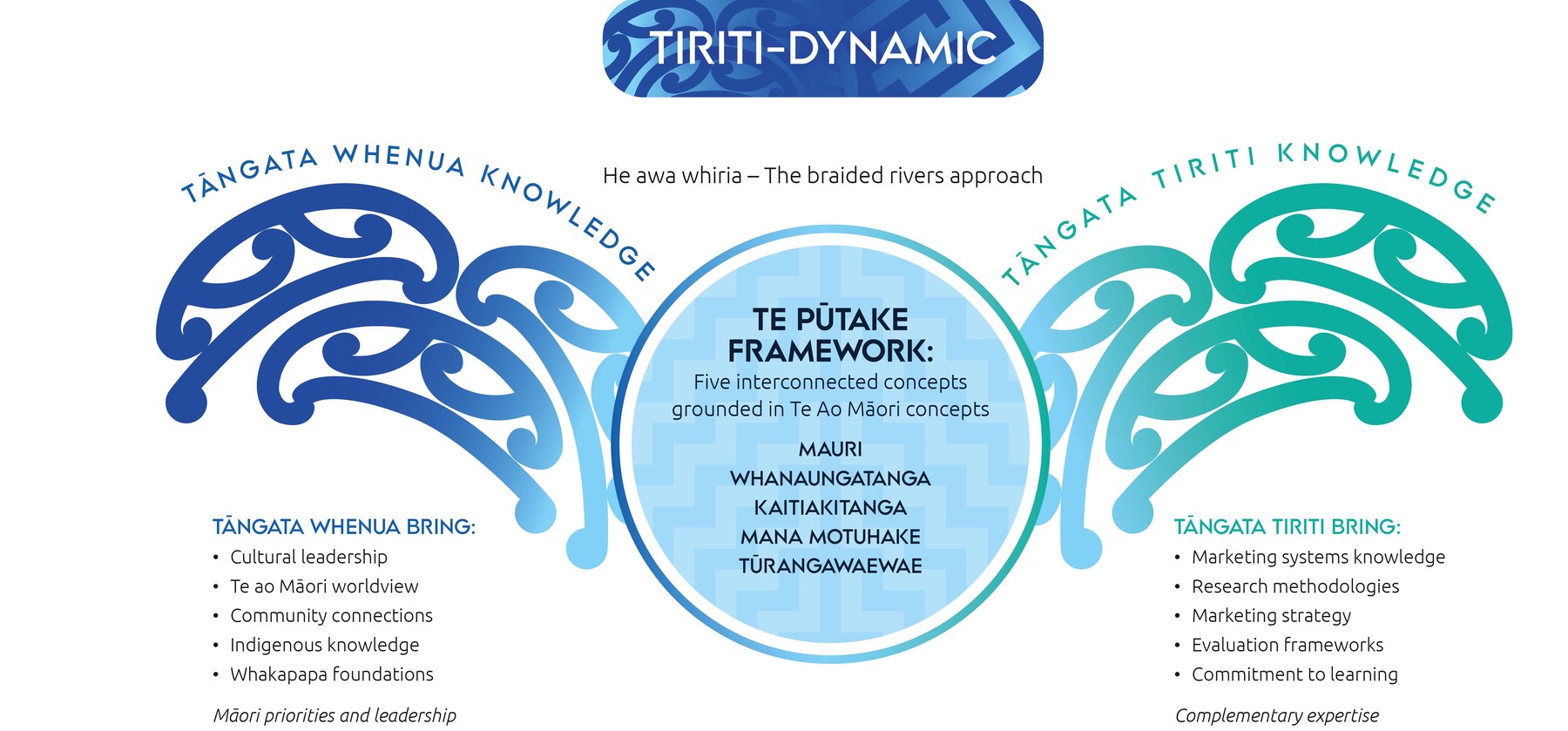
He Awa Whiria as a formal framework was created in 2011 by the late Professor Angus Macfarlane — a pioneering educational and psychological researcher — alongside Associate Professor Sonja Macfarlane. We use it here with acknowledgement and gratitude. Moe mai rā, e te rangatira.
06 Te Tiriti as a model
Partnership as a working practice.
Te Tiriti o Waitangi isn't only the founding constitutional document of Aotearoa. It's a working model for how two parties can be in genuine partnership — preserving the mana motuhake of each, while creating something neither could create alone.
For leaders, that's more useful than most management theory. It applies to how you work with iwi and hapū. It applies to how you work with your team. It applies to how your board operates, how your executive holds power, how decisions get made.
Tiriti-dynamic leadership takes Te Tiriti seriously — as a practical guide to partnership, not a karakia at the start of a hui.
07 Whakapapa
Where this kaupapa came from.
This kaupapa didn't appear from nowhere. It sits on the shoulders of researchers, practitioners, and hapori who've been building this thinking for years. We acknowledge that whakapapa openly.
The late Professor Angus Macfarlane, alongside Associate Professor Sonja Macfarlane, creates the He Awa Whiria (Braided Rivers) framework. Our kaupapa rests on this foundational mahi.
Te Hiringa Hauora's foundational mahi on Tiriti-dynamic health promotion — the conceptual base this practice grew from.
The SWEET² framework — co-authored by Tim during his time at Bay of Plenty District Health Board — is taken up by health providers across Aotearoa. Early proof that Tiriti-grounded practice could spread.
Hemisphere and Big River Creative form their formal rangapū — putting the kaupapa into agency practice.
Tim Antric and Te Awanui Reeder publish Tiriti-Dynamic Social Marketing: A Framework for Transformative Practice in Aotearoa New Zealand in the Journal of Social Marketing.
Brooke Hayward (lead author), Patricia Vermillion Peirce, Tim Antric and Te Awanui Reeder publish Whānau first: a culturally responsive evaluation of the F.A.S.T. stroke campaign in Aotearoa New Zealand — extending the framework into evaluation practice.
Kōrero with Te Taura Whiri i te Reo Māori and Hui E! Community Aotearoa to test the practice across sectors.
Presented at the Australian Association of Social Marketing — the framework crosses into the international community of practice.
This site. The kaupapa now extended to leadership practice.
Curious how this applies to your context?
Every organisation is different. Every leadership team is different. The way Tiriti-dynamic practice shows up in your mahi is something we work out together.
Start a kōrero →